

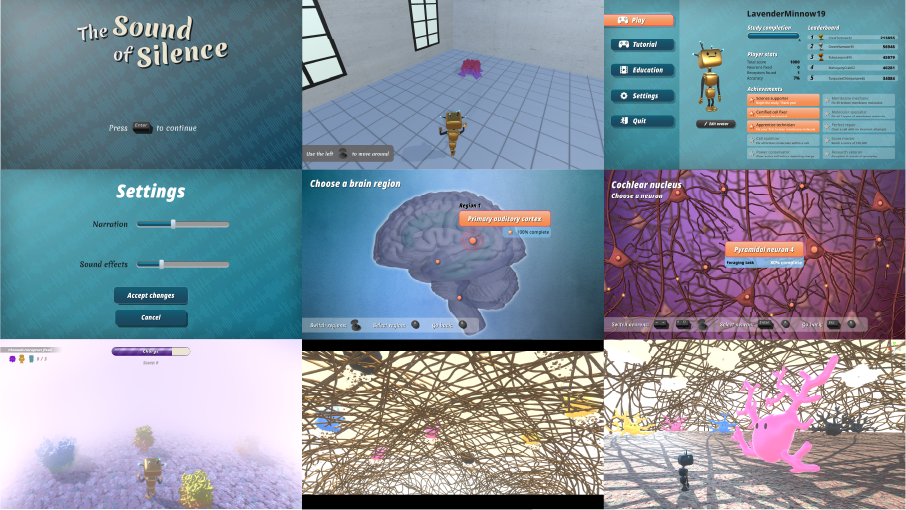
The Sound of Silence
I had the privilege of being the lead artist for a video game being designed as a treatment for hearing disorders under development in Dr. Dan Polley’s neuroscience lab affiliated with Mass Eye and Ear and Harvard Medical School. Being on a small team meant a rare opportunity for hands-on involvement across the entire game development pipeline – but also meant decisions were often driven by what could realistically be built in the time available, a narrower scope than a typically larger team could tackle.
Design decisions were grounded in research on video game cognition and affordances and shaped by tradeoffs between workflows (e.g., pre-rendered art vs. adaptable components) and technical implementation (e.g., Unity’s render types, Canvas vs. UI Toolkit). I used eye-tracking data to understand and direct player’s attention through UI, researched controller options against gameplay and hardware requirements, and helped build early documentation – flow charts, story progression outlines, production workflows for the various software – to stay organized as scope increased. Game screens were designed by weighing menu-based versus environment-based interaction. It was also important to balance satisfying feedback against a unique constraint: as an auditory neuroscience tool, the game required strict control over sensory stimuli and visual design that supported immersive gameplay without interfering.
Visual production spanned concept art, 3D character modeling, environmental design, texturing/shading, animation, effects, and UI implementation in Blender, Photoshop, Illustrator, and Unity. Protein structures were pulled from the Protein Data Bank, modified and textured for use as game asset. Background art and animations were implemented to bring the non-gameplay sections to life. Much of the setup of the art assets required knowledge of Unity workflows and C# programming.
Being a solo artist on a full visual pipeline for a video game is challenging, but it is also a genuine gift to merge so many technical and artistic skills, both old and newly learned, together in a single project.